Schedule a Demo of Our Services
Complete the form below and we will be in touch shortly to schedule your demo.


As someone that has been working with content management systems like Drupal and AEM for nearly two decades, one challenge repeats itself on every project: how do you migrate content from the old platform to the new platform efficiently? Content migrations can be automated, manual, or a mix of both. But how do you decide what content to migrate using automation and what content to migrate manually?
Before deciding how to migrate the content, it is important to understand what the desired outcome is. The desired outcome is different from one project to the next and is key to defining the content migration plan. Is the content up to date or does it need to be refreshed? Is there content that is no longer relevant? When was the last time the content was audited and have the audit recommendations been implemented? If the content is fresh and relevant, the migration plan is simpler than if the content needs a major overhaul.
A content migration plan is used to document the approach, data mappings, and the tools and processes to be used. While there are common approaches, tools, and processes, every content migration is unique. What worked for one content migration may not work for your content migration.
The approach in a content migration plan describes how the content will be migrated from the old platform to the new platform. The approach’s goal should be to automate as much of the migration as makes sense. The website’s content makeup will dictate what makes sense to automate. One-off pages like the home page or unique landing pages are good candidates for manual migrations, because of their uniqueness and complexity. News, events, and blog pages that are highly structured and have large quantities of pages tend to be good candidates for automated migrations. Pages that require few, if any, layout decisions to be made are easier to automate the migration than pages with intricate designs that require many layout decisions. The chart below lists a few example websites and the best approach.
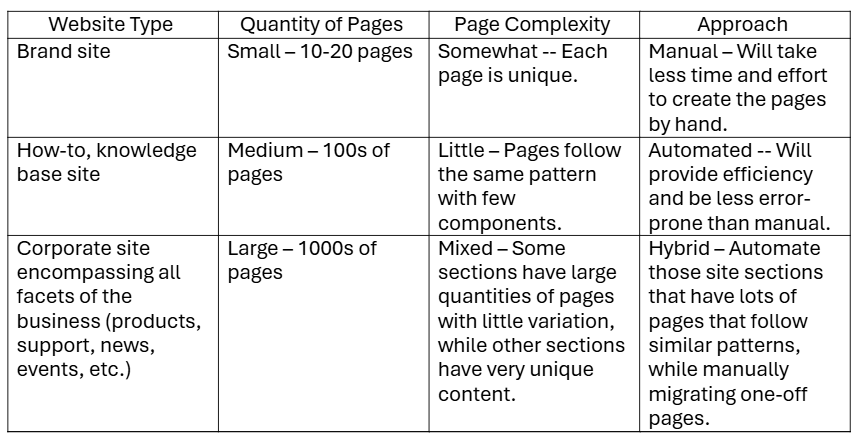
Solidifying the content migration approach and classifying pages and categories of pages needing to be migrated manually or using an automated process is a great step. With that in place, you can decide which tool to use to automate page migration. In a future post, I’ll discuss some commonly used tools to automate content migration, including new AI-based SaaS tools with the promise to turbocharge the migration process.