Schedule a Demo of Our Services
Complete the form below and we will be in touch shortly to schedule your demo.


There is a conversation that tends to happen late in enterprise marketing projects, usually after the decisions have already been made. It usually starts with a CRM migration announcement. Or an acquisition. Or a platform consolidation. Something shifts at the infrastructure level and suddenly the marketing team, which had nothing to do with the decision, is staring at a stack of broken integrations and a go-live date that cannot be moved.
Most marketing stacks are built as a direct line between two systems. The marketing automation platform on one end, the CRM on the other. Contacts sync one way, engagement data flows the other, and the scoring model lives inside the marketing platform.

This works beautifully when nothing moves. The trouble is that in enterprise organizations, things move constantly. CRMs get replaced. Companies get acquired. Platforms get consolidated. Regulatory requirements change what data can live where. The marketing stack is almost never the reason for these changes, but it feels every single one of them.
When the direct line between marketing and CRM breaks, the whole operation breaks with it. The scoring model goes quiet. The audiences go stale. The preference data stops syncing. The team that was running sophisticated, data-driven campaigns is suddenly doing triage on integrations at exactly the moment they have the least capacity to do so.
The instinct is to rebuild the connections as quickly as possible. Rewire the new platform to the new CRM, recreate the field mappings, reestablish the syncs – get things running again. This works until the next change, and in organizations going through the kind of transformation that involves replacing foundational systems, there is always a next change. What rarely gets asked in the middle of that scramble is whether the architecture itself is the problem. Whether the direct line was ever the right way to build this in the first place.
There is a different approach, and it starts with changing what the central system of record for marketing actually is. Instead of building a direct connection between the marketing platform and the CRM, both systems connect to a shared data layer. Platforms like Databricks, Snowflake, and BigQuery are common examples of this. The data layer holds the contact records, the behavioral history, the scoring inputs, the preference flags, the identity resolution logic. The marketing platform reads from it and writes to it. The CRM does the same. Neither system needs to know what the other is doing, because they are not talking to each other. They are both talking to the same source of truth.
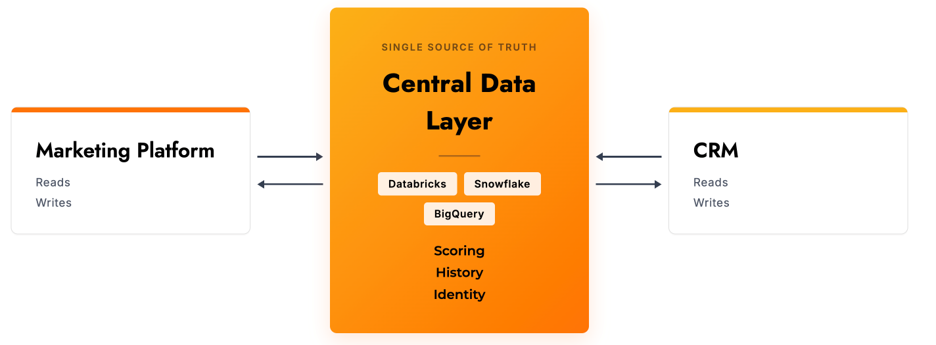
When the CRM changes in this architecture, the marketing operation does not notice. The data layer did not change. The connector to the new CRM is a new problem, but it is a connector problem, and connector problems are manageable. Data loss is not.
That is the resilience argument, and it is a good one. But it is also the narrowest version of the case. Most organizations are not planning to change their CRM. So why should they care? The answer is what this architecture makes possible when nothing is changing at all.
When behavioral data lives in a central data layer rather than inside the marketing platform, the scoring model is no longer limited to the signals that flow through that one tool. Web behavior, video engagement, intent signals from third-party sources, event attendance, product usage data – all of it can feed the same model. The audience you build from that model is a fundamentally different thing from the audience you build inside a siloed platform. It reflects the full customer, not the slice of the customer your marketing tool happens to see.
Historical continuity is the second benefit that rarely gets enough attention. Marketing platforms accumulate years of behavioral data. When organizations switch platforms, that history almost never makes the move cleanly. It gets exported, partially, in formats that do not always map to the new system, and what does not make it over quietly disappears. When the history lives in the data layer, it does not go anywhere. The platform switches. The history stays. Every future tool that connects to the same data layer inherits the full record of every tool that came before it.
There is also a longer-term consequence worth naming here that connects back to the resilience argument. Organizations that have spent years inside a single marketing platform often stay longer than they should. Not because the platform is the best fit anymore but because leaving means losing the behavioral history that has accumulated inside it. When history lives in the data layer instead of inside the platform, leaving becomes a procurement decision rather than a data recovery project. And for larger organizations managing different teams, regions, or business units with different needs, the central data layer makes it possible to run more than one marketing tool simultaneously without fragmenting the customer record or the scoring model. The data layer holds everything together regardless of what sits on top of it.
At enterprise scale, with multiple business units, multiple brands, or multiple regional markets each potentially running their own systems, this kind of composability is not a nice-to-have. It is the difference between a marketing operation that can adapt and one that cannot.
This architecture is best suited for enterprise organizations managing large contact databases, multiple data sources, and the complexity that comes with operating at scale. For organizations earlier in their data journey, a direct connection between marketing platform and CRM is often the right pragmatic choice. For those where complexity and scale make the cost of disruption high, it requires investment in the data layer before the pain of not having it is obvious, which means this approach requires leadership willing to solve a problem they have not yet felt.
For enterprise organizations managing large contact populations, multiple data sources, and the kind of platform complexity that comes with real scale, the question is not whether to build this way. The question is whether to build it before the next disruption or during it. The organizations that build it before have options. The ones that build it during are in damage control.
The floor will move again. It always does. The marketing teams that handle it best are not the ones that rebuild fastest. They are the ones that stop building directly on top of it.